TO A LIGHTHOUSE – Part III

TO A LIGHTHOUSE – Part III

TO A LIGHTHOUSE – Part III

On the road again, we head north to the town of Pescadero and Duarte’s restaurant, famous for its artichoke soup. It’s a rustic tavern with wood-paneled walls and huntsmen’s trophies overhead—sets of deer antlers with and without heads. I marvel again at how beautiful deer faces are and wonder how anyone can bear to shoot them.

Earl tells me about his friend Hank from his Greenwich Village days answering a classified ad for a used something-or-other—and after going to buy it from the seller, commenting to Earl ingenuously, “And isn’t it a coincidence that his name was Norman Mailer, just like the novelist?” Earl’s circle of friends and acquaintances back then included Jack Kerouac, as well as Mailer, and other up-and-coming writers and artists of the time. He lived on the fourth floor of what had been a factory with his wife Moira, who was also a painter—and looked like the Egyptian queen Nefertiti, he swears. The “loft,” as they called it, was 2500 square feet (with the requisite skylights), which his friend Jimmy and he partitioned into three studios and a living space, using the wood from packing crates they scavenged in the neighborhood. He and Moira had a Siamese cat named Sheba that gave birth to a strange litter of kittens—Eightball, Oddball, Blackball, and Fink, they called them. Eightball, the one they kept, was huge and curly-haired, which led them to speculate he might have been sired by a bobcat. He used to climb up the back of Earl’s easel and jump up into one of the skylights, where he hunkered down on a beam and watched Earl paint with rapt attention for hours on end.

“Did you and Moira have a church wedding?” I ask. They were married by a Unitarian minister, he says, and Moira wore a blue cocktail dress. They had to cut back the guest list when her father, a graphic artist who worked for Disney, among other jobs, went bankrupt for the umpteenth time, and they realized they were going to have to pay for the wedding themselves. But the celebrated painter Hans Hoffman, Earl’s mentor, attended with his wife. And their weird friend Syd, who, after poring over the paintings in the Metropolitan Museum, showed up at the Hoffman School, announcing at the reception desk he wanted to learn to paint like Delacroix. “That’s good enough,” said Hoffman, who happened to be standing nearby—and promptly admitted him.

When Earl talks about Moira, I think to myself, “She was the love of his life.” And I wonder how much competition had to do with the failure of their marriage. “If I was the better painter, she was the better artist,” Earl once told me. But the art world has always been an exclusive men’s club—and so while Earl won prizes and was offered teaching positions, Moira was left to watch from the sidelines.
COMMUNITY

COMMUNITY

COMMUNITY

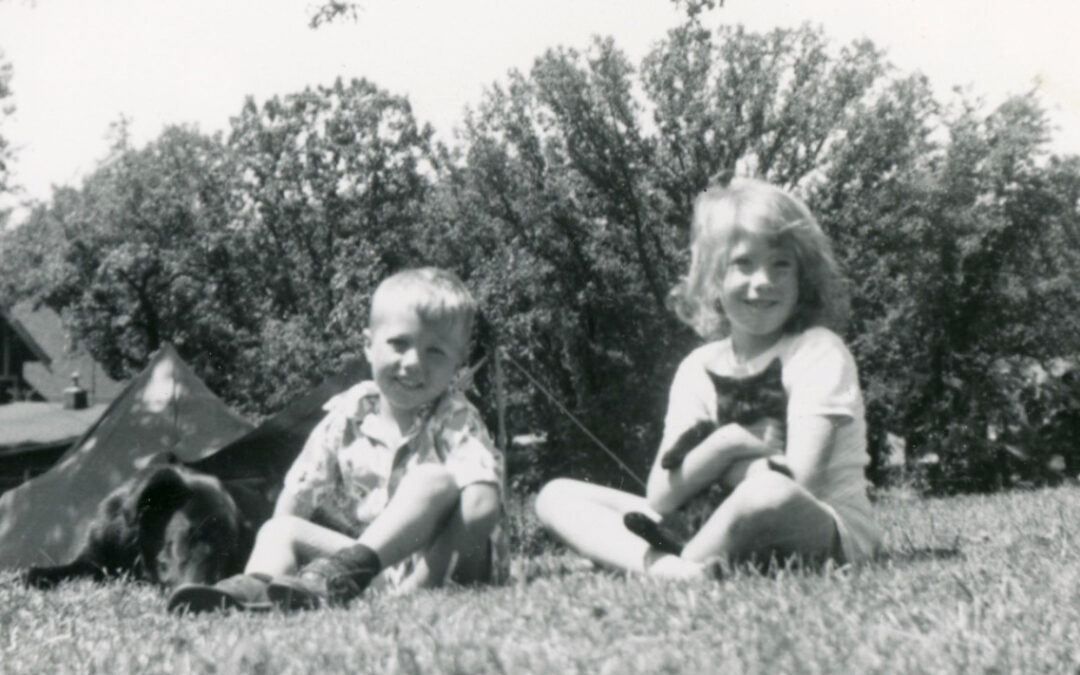
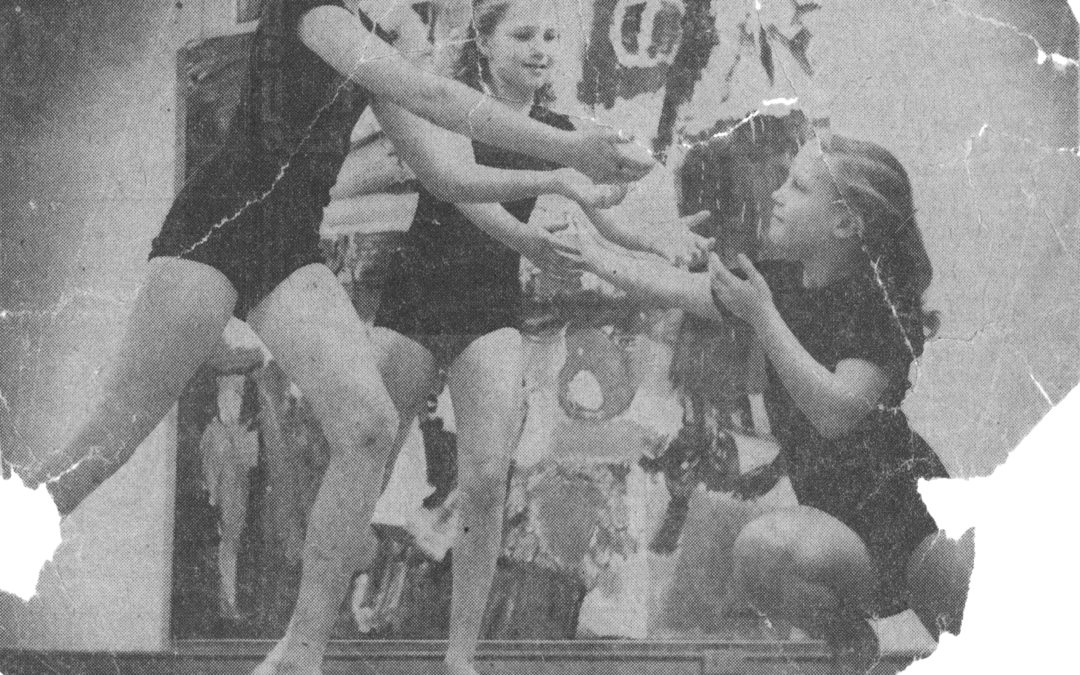
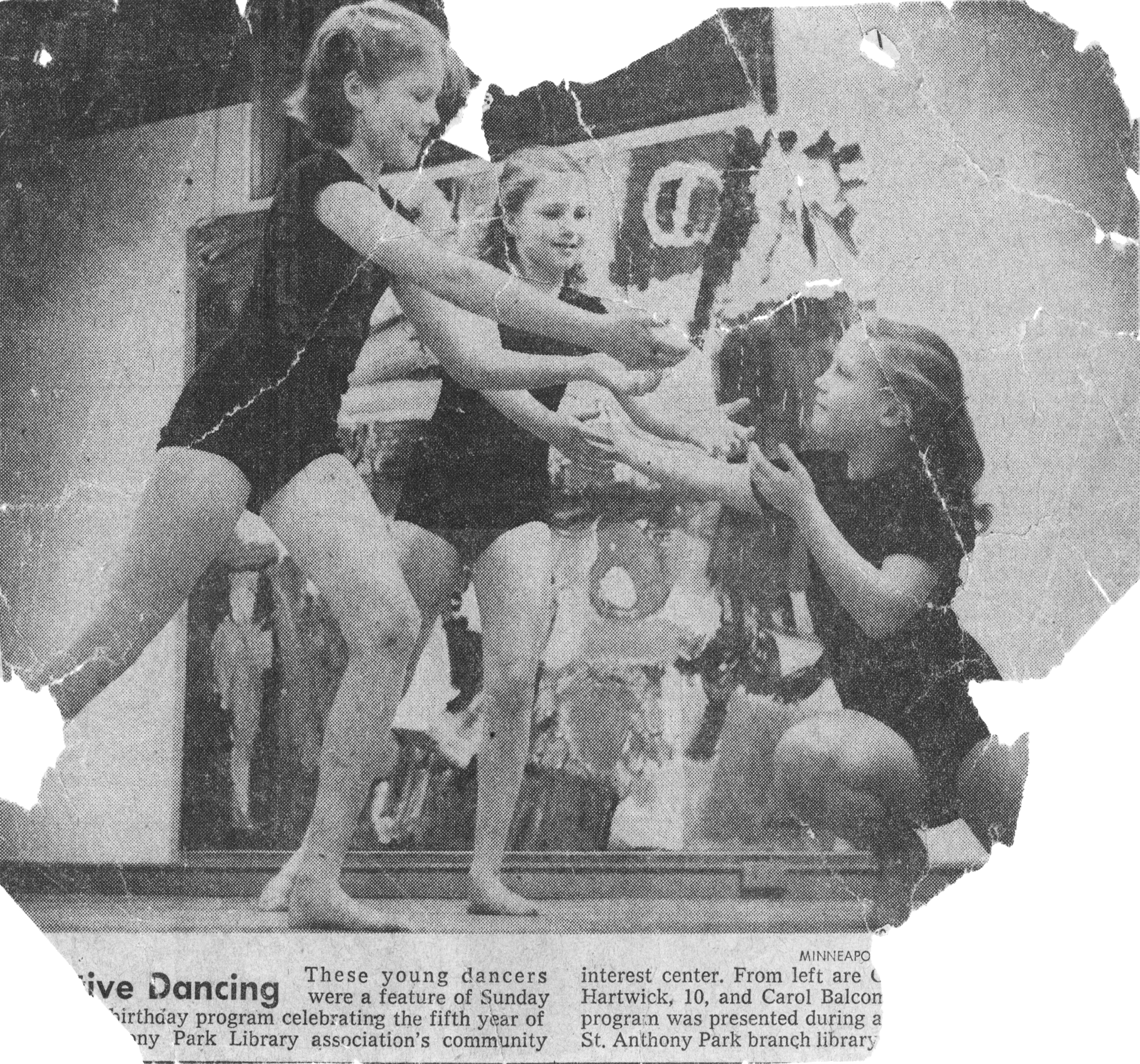
                                        From left to right, me, Kathy, and Carol Balcome.

I was seven when we moved into the upper half of a duplex on Raymond Ave, an apartment only a fraction of the size of our Dudley home and, speaking of losses, the first thing I remember is my cat, Timmy, running away. More than once we went back to the old neighborhood to search for him—without success.

In the living room we had modern blond-wood furniture, a sofa with stylized fish on it, matchstick blinds on the front window, and, to either side, a small, framed print of San Francisco that Mom had brought from California. The room looked out onto a residential street lined with elm, oak, and maple trees, and, unlike in Berkeley, the view wasn’t obstructed by telephone poles and wires—or fences around or between the houses either. And, as I said when I wrote my blog “The Expurgated Version,” there were cases of butterflies, moths, and beetles all around the room.

After first grade at University Elementary School, I decided that I wanted to go to the local school with the kids who were my neighbors instead. My parents acquiesced, and in the fall Doug and I started at brand-new St. Anthony Park Elementary School. (“Gutterdump” had been torn down.) When I look back on this decision of mine, I realize I was needing a sense of community that was lacking in my life.

I soon became best friends with my neighbor across the street, Wolfy, and down the block, Kathy. Before long I was taking modern dance lessons in the basement of the local library with girls from my class—Mary, Margie, and Susie—and had joined Bluebirds, where I remember making a tom-tom out of a coffee can and a scrap of rubber tire, as well as a paper mache cat that I decided was ugly. At Christmastime we sold peanut candy door to door. Summers, Kathy and I went to Bluebird camp on Lake Cheewin together, where we swam, rode horses, and learned songs like “This Land is Your Land” and “The Happy Wanderer” that we sang as duets year around. Or we sang rounds like “White Choral Bells”:

White choral bells upon a slender stalk

Lilies of the valley deck my garden walk

Oh, don’t you wish that you could hear them ring?

That will happen only when the fairies sing.

On the fourth of July all the kids in St. Anthony Park gathered for a costume parade at Miller’s Drugstore and marched down Como Avenue to Langford Park, where our school stood. There was a bandstand with music, games and races, a treasure hunt, and, in the evening, fireworks.

INHUMANE

INHUMANE

INHUMANE

When I was four, we moved to New Haven for a year so my dad could get his Ph.D. in philosophy at Yale. Doug and I went to an all-day preschool run by three black women. I loved Miss Green, while Doug’s favorite was Miss Brown.

For the first months back in Minnesota, when I was five, we were unsettled. I went to two different kindergartens before we rented an old two-story house on Dudley Street in St. Paul, and I started attending Gutterson Elementary School—“Gutterdump,” as the kids called it—a staid, old-fashioned red brick building with an asphalt playground. It was there I was sent to the principal’s office, not to be disciplined but to show her the drawing I’d done of my class having a parade. Her office was on the second floor, however, and when I reached the top of the stairs and looked around, I couldn’t tell where I was supposed to go. So I went back downstairs and only pretended to my teacher that I’d done what she asked. (I no longer know what my parade drawing looked like, because the first example of my artwork in my childhood scrapbook is a turkey, also drawn when I was five. Just for the fun of it, I’ve updated that turkey and plan to post both versions in my upcoming Thanksgiving blog.)

Another memory I have, besides being scolded once for whispering during nap time, is of asking a first grader on the playground if it was hard to learn to read—because I was already anxious about my ability to master this skill.

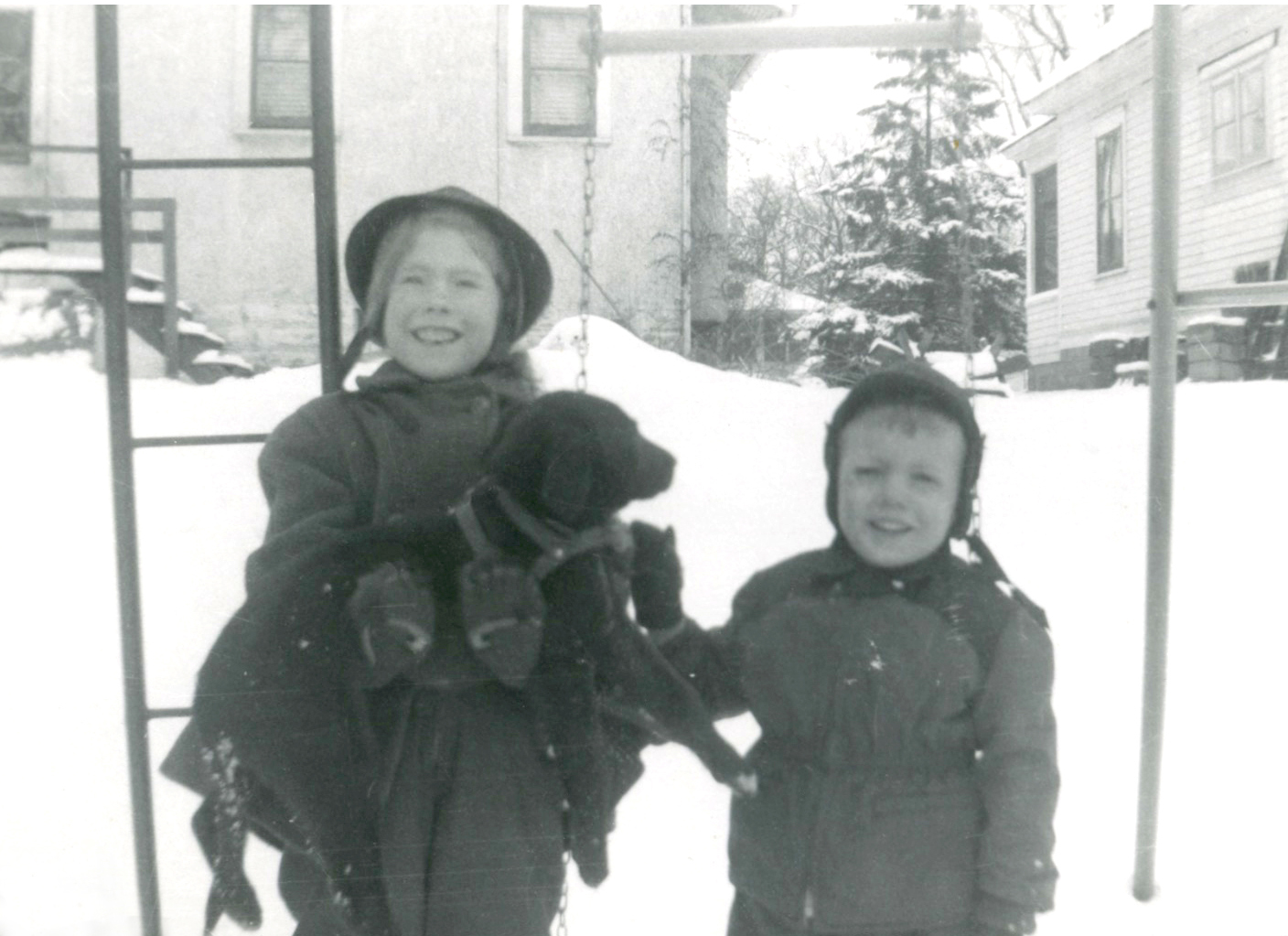
The Dudley house had a row of pink peonies on one side of the front lawn. (I still remember the sticky sap on the buds and how they swarmed with ants.) There was an ample backyard, where we had a swing set—and where my dad built a snow igloo that winter for Doug and me to play in. Behind the garage, a previous tenant had planted corn, melons, and asparagus that we ate—well, except for the melons, which usually were stolen before they were completely ripe. My dad got my brother a black lab we called Blackie and a black cat for me, Timmy.

On Halloween I went in costume to our next-door neighbor’s house by myself, and when Mr. Landis opened the door, I said “Trick or Treat,” as instructed. Instead of giving me a treat, however, he said, “What’s your trick?” Confused and bewildered, I turned and ran home.

For Christmas we got a tree so big that Dad had to cut off the top. One evening we went to downtown Minneapolis to see the windows of Dayton’s Department Store, where they had festive scenes like Santa’s workshop with mechanical elves.

Sometimes Dad would have to stop by his office on our way home from somewhere. We would drive through “Dinky Town,” where the college kids hung out, a name I’ve always remembered because it seemed so cute to me. Then my dad would park behind the Philosophy Dept. building and Doug and I would wait in the car for what always seemed like an eternity. My father never actually took us inside, so I have no idea what his work environs looked like.

Before Easter that year, when just my dad and I were in the car, he stopped at a store and came out with a pink box. He said he’d bought a cake and put it in the backseat. But I could have sworn I heard sounds coming from the box. It wasn’t until we got home that I discovered he’d bought me a little duckling.

He made a tiny cage for it—a foot square, out of wood and chicken wire—that we kept out by the garage. When I let my duckling out of its cage, it would chase me all around the yard, which delighted me.

But then our neighbor, Jack Landis, told my father that it was inhumane to keep a duck in such a small enclosure. My father claimed at the time that he called some expert at the Farm Campus of the university who assured him that it wasn’t inhumane. Though my father was fascinated by animals, he was convinced that they didn’t have feelings, a hard thing for me to understand since they so obviously do. In a similar way, he would renege on his promise to pay for my braces years later, claiming my dentist had assured him that having protruding teeth wouldn’t damage my self-esteem, and, even more years later, when I insisted that sexual abuse was always hurtful to children, he would claim that the “foremost expert on child development” had reassured him that it wasn’t.

I gave my duck to the Como Park Zoo to live out what I hoped was a happy life, and to this day, I’ve never eaten duck.

DARK SECRET

DARK SECRET

DARK SECRET


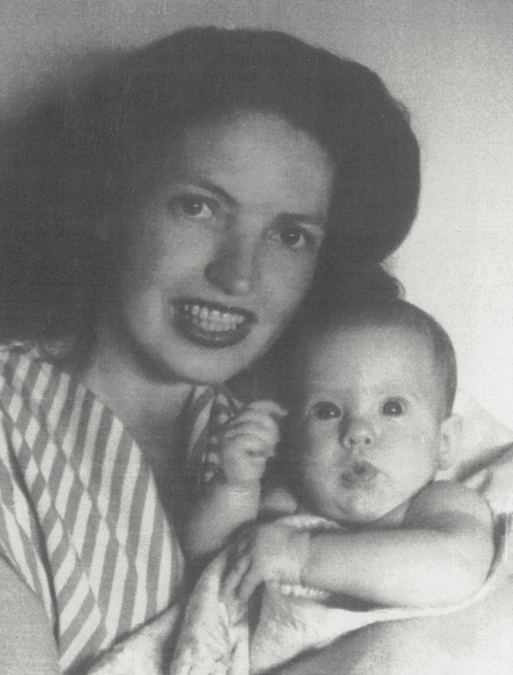
I love this picture of my mom and me. She was twenty-five when I was born and couldn’t have looked more glamorous, in my humble opinion. She’d married my dad the year before, after meeting him at a hospital in California where she was stationed as a WAC (Women’s Army Corp). She was so attractive she had a host of admirers—her “smooth half dozen,” as a friend called them. My dad approached her, asking if she could introduce him to the brainiest WACS she knew. At one point in their conversation, when he attributed to the wrong author the quote “Malt does more than Milton can to justify God’s ways to man,” she corrected him, telling him it was A. E. Housman. That was the moment he decided she was smart enough. Though they only dated briefly before he was sent back to the hospital where he headed up a pathology lab, he was quick to propose to her, worried that some other guy would beat him to it if he didn’t move fast.

What I didn’t know until years later was that my mom had been engaged to a man called Jimmy, and that the wedding invitations had already been sent out when a girl from his hometown showed up pregnant with a child she claimed was his. She—my mom—had married my dad on the rebound, she confessed to me; humiliated by Jimmy, who went home and married the other girl, she was trying to save face. As for my parents’ nuptials, all I know is this: They were married by a female justice of the peace, Mom wore a suit instead of a wedding dress, they honeymooned in southern California, and on the way to Minnesota, the train caught fire and Mom’s trousseau went up in smoke.

I’ve already written about the Quonset hut we lived in while my parents continued their college educations at the University of Minnesota on the G.I. Bill. It was only a few years ago that I asked Mom what memories she had of me as a baby. “You drooled a lot,” was her first recollection. “Do you remember my first word?” I asked. “You pointed at the fixture on the ceiling,” she told me, “and said ‘light.’” (I love that!)

Later she recounted how, as soon as she’d started having contractions the morning of my birth, a friend had driven her and my dad to the hospital since they didn’t own a car. I made my debut before my father had even finished filling out the necessary paperwork.

It was the happiest day of her life, my mother reminisced. Unlike when my brother was born, however, the hospital didn’t allow babies to stay with their mothers, she explained, but put them in a nursery after birth. So the only time we spent together during those first few days was when she breast-fed me. (That, I find appalling.)

Some time later she stopped nursing me because I bit her, she admitted. They didn’t have pacifiers back then, so I started sucking my thumb…with the result my baby teeth came in with a space between two of them. (Now I’m remembering that, according to one dentist, this had caused my adult teeth to come in with a space too.) Also, Mom told me, my nose was smashed to one side when I was born. (OK, my nose is still turned slightly to one side, but then, so is Harrison Ford’s.) Both my cousin Mark and I were very obviously pigeon-toed at birth, but while Nat and Ray (my aunt and uncle) had him wear baby shoes with a metal bar between them at night to help his feet and legs grow straighter, she and Dad didn’t with me, worried that I’d be too uncomfortable. (Instead I wound up wearing Stride-Rite saddle shoes throughout elementary school.)

Mom also recalled a day she came home and found I was gone, an absence that my father hadn’t noticed. They discovered me toddling around the neighborhood—on an odyssey I like to think was prompted by an adventurous spirit.

As for the day my brother was burned, I don’t have any memory of how he wound up on the floor beside his stroller, with his cheek pressed against the floor heater. As I wrote in my blog “Catastrophe,” I was told I must have left his stroller by the heater, maybe even overturned it as I pushed him around. But there was more to the story, as I’ve said:

The secret my mom would keep over the subsequent decades was that, though she heard my brother’s scream, she didn’t come right away. She’d been in the next room, writing a letter—and instead of jumping up and rushing to see what was wrong, she’d kept on writing until she finished the sentence.

I have a hunch I’m the only one she ever told this to—and she didn’t have to spell out to me that her delay might have caused my six-month-old brother’s third-degree burn, rather than a milder one.

As for my interpretation of my dream, I think it expressed a truth about me—that even if it didn’t show, I was deeply scarred by that tragedy as well.


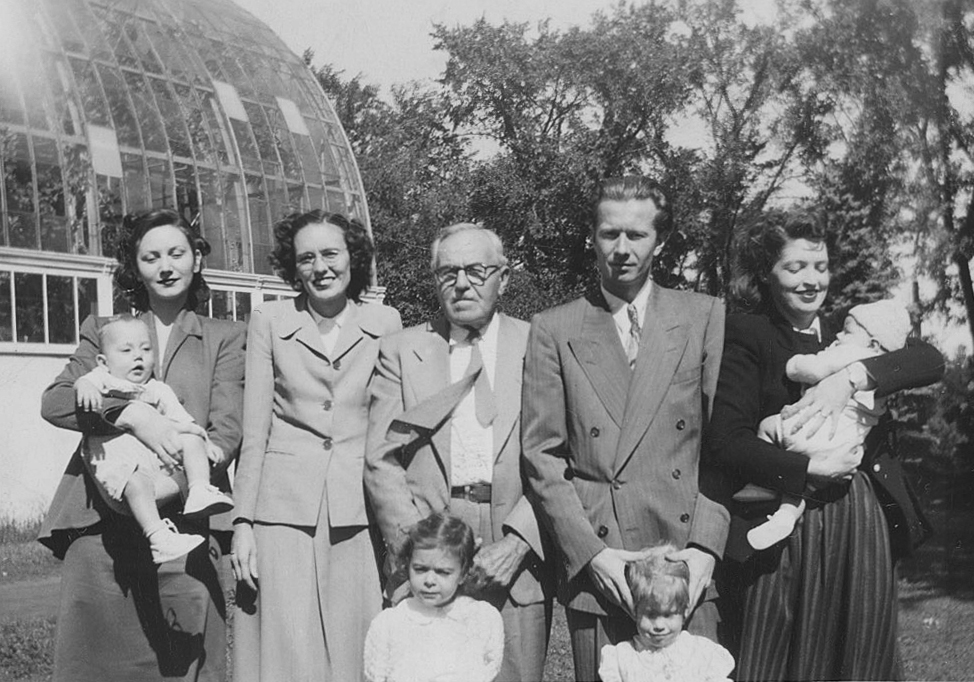
At the center of this family photo is my grandfather Frank, his third wife Marie and daughter Margret who is my age. On the left is Nat and Mark. There’s no sign of my uncle Ray, so he must be taking the picture.


MIRROR IMAGE

MIRROR IMAGE

MIRROR IMAGE

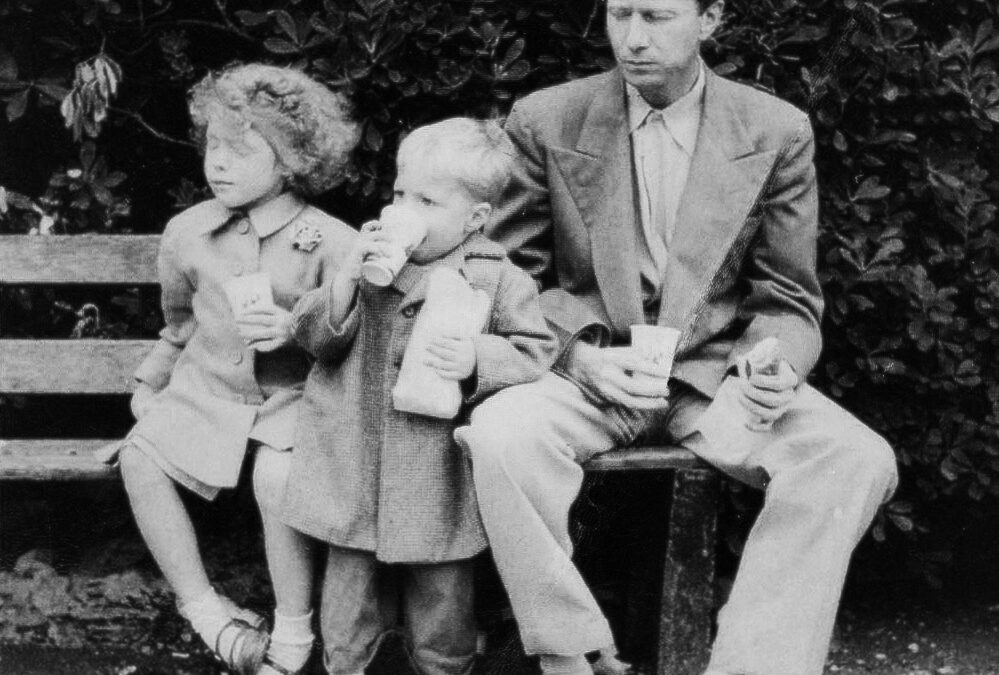
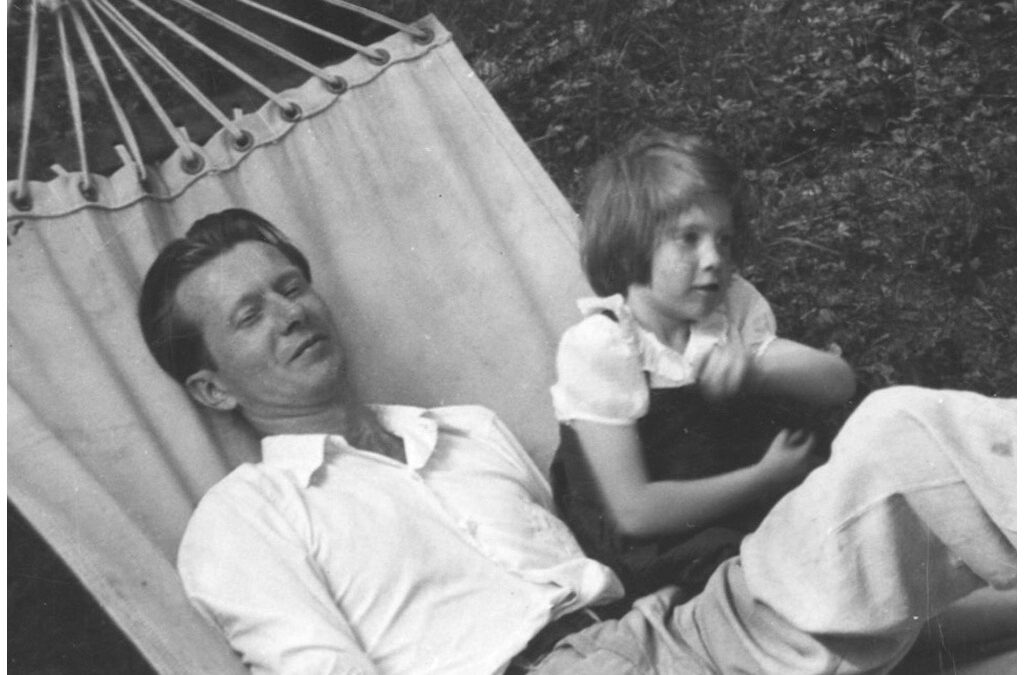
I don’t have many pictures of my dad and me together. (And contrary to what my computer thinks, “me” is correct because it’s the object of a preposition, a rule that nobody seems to remember anymore.) There we both are with our eyes closed, holding our drinks, legs sprawling—unlike my brother whose eyes are open and who’s drinking out of his cup. If you could see the picture in color, as it once was before it faded to sepia, you would see my dad are both freckled redheads…and, the truth is, we are very alike in many ways, even beyond our physical appearance. But my attitude in the snapshot is a mirror image of his, with my cup in the opposite hand and my leg curled in the opposite direction. How telling, I think to myself—because in other ways, I’m my father’s opposite—the negative to his positive. For my father was always unassailably sure of himself, implacably secure in the knowledge of his intellectual superiority to just about everybody else. He didn’t seem to have many of the feelings most of the rest of us do. He didn’t experience fear—of death, for example—or anxiety, like the paralyzing the performance fright I still struggle with—or depression, which hung over my life from puberty until my mid-thirties, with only a few bright spots. I was ever his polar opposite, experiencing intensely all the feelings he didn’t. And that, of course, was no accident.

FATALITY

FATALITY

FATALITY

Margret also sent me, carefully packed in styrofoam peanuts and sealed in plastic bags, the christening gown my grandmother Marie made my father before his birth and the Bible my grandfather Frank gave her when she converted to Catholicism.

Frank was a chemical engineer who designed city water systems and was already in his mid-thirties when he married Marie, one of his technicians. Not long ago, my mother told me that it was my grandfather who insisted she have their baby in the hospital—at a time when most women, with the help of midwives, were still delivering at home. Apparently he believed she’d get better care there. But twelve days after giving birth to a healthy red-haired baby boy, my grandmother died in the hospital of “childbirth fever,” caused by unsterile conditions. Family lore has it that if the baby had been delivered at home by a midwife, Marie probably would have survived. This conjecture was buttressed in my own mind by a TV documentary I saw about Martha Ballard, a midwife who delivered a thousand mothers a hundred years earlier—and never lost a one. My grandmother Marie was only twenty-three.

Like Scrooge’s father in “A Christmas Carole,” my grandfather blamed his infant son for his young wife’s death—and treated him forever after that with resentful hostility. It’s even likely that he hit my father as an infant in the cradle, because that’s what he did years later to Margret. After Marie’s death, my grandfather’s sister, Julia, came to live with them and take care of my father, so for years he thought she was his mother. But when my dad was seven, Frank remarried—Estelle, a sadistic, perhaps even psychotic woman, by all accounts. Julia was sent away, and Estelle gave birth to a son. My father described to me once how Estelle used to strip his half-brother Ray when he was a boy, put him in the bathtub, and beat him mercilessly with an iron cord. And though my father insists Estelle never beat him, Ray told me she deliberately put rotten meat in my father’s sandwiches. In the Catholic school they attended, the nuns were physically abusive, as well. My father said one nun smacked a classmate of his on the side of the head and permanently deafened him in one ear. So perhaps it wasn’t surprising that my father eventually repudiated the religion of his tormentors. While still a teenager, he decided there was no God. The only thing that was painful about reaching this conclusion, he told me, was the thought that he would never meet his mother in heaven.

What struck me after reading “ The Black Lyre” was how like Ariphanes my father was—an unwanted child, an orphan in a sense, whose extraordinary gifts were scorned by the “pious” adults around him—an embittered father who couldn’t love him, a brutal stepmother who seemed intent on poisoning him, tyrannical nuns who ruled their classrooms by intimidation and physical abuse…. When he grew up, the revenge he took was Ariphanes’. He spent his entire professional life proselytizing against religion; in philosophical papers and university classes, he tried with his instrument—not a lyre but his exceptional powers of logic—to create doubt and undermine faith wherever he found it.

JOLTED

JOLTED

JOLTED

I have eight photos of my beautiful Swedish grandmother Marie, my father’s mother. In a blurry one, she’s sitting cross-legged in a field, bundled in a light jacket, her long skirt wrapped around her feet. Her hands are resting in her lap, a jaunty straw hat with a large bowl shading her eyes. Her head is cocked charmingly, the slanting sun lighting up the hat, casting the shadow of her nose across her cheek and catching the full breadth of her engaging smile.

My half-aunt Margret, who’s my age and like a cousin to me, recently sent me a ninth—a photograph of my grandparents she’d found in a chest in her attic. They’re sitting in the grass in a park. Without her hat, you can see my grandmother’s hair is fair, and I’ve always wondered if she was a strawberry blond like me. Her collar has a tassel, her dress a cummerbund, and her shoulders look thin and angular, like mine. The brown oval mat that frames the two of them is crumbling with age. I’m torn: out of reverence, I want to keep the photo just as it is; out of aesthetic compunction, I want to strip away the moldering mat. With a razor I slit open the paper backing, only to find the photo fixed in place with a battery of tiny rusted nails. Using pliers and a screwdriver, I carefully bend and jiggle them free.

When I finally pry the oval mat from the photo, I see, in a corner that was hidden, three women in broad-brimmed hats strolling on a path beyond the shrubbery—in another second they would have passed beyond view. And suddenly, I’m jolted—shocked—into an apprehension of the moment: that one instant of that one day, when my grandparents were in love and thought they had all the time in the world.

OXYMORON

OXYMORON

OXYMORON

Have I mentioned that I’m a member of BAIPA—the Bay Area Independent Publishers Association—which meets monthly in Novato, across the Richmond Bridge from Berkeley? It’s a thriving group that includes writers of all ages, editors, illustrators, graphic artists, printers, marketing experts, audio book actors, and more. When I first joined, I wrote in my journal:

“Wow! I just attended my second BAIPA meeting, and I have more than a sneaking suspicion that it’s going to be life-changing—because I’m an introvert of long standing.

“Last year before my goddaughter Arielle left to spend her high school junior year in Viterbo, Italy, I had her sign me up on Facebook. And though I loved seeing the pictures she posted of her travels on her Facebook page, my own page has remained faceless ever since—a gray ghost with a flip. (How’s that for an oxymoron? A faceless Facebook page!)

“But now that I’m preparing to self-publish my children’s books, I see I’m going to have to mend my inconspicuous ways. (Actually, I did take a few pictures of myself when I got my first iMac last February—and while I was pleased that the flash on my new computer blasted away most of my wrinkles in the photos, I couldn’t bring myself to post any of the shots on my Facebook page because…well, the closet door was open behind me in the background, revealing all the clutter inside. I have my pride.)

“Come to think of it, I’ve avoided having my picture taken ever since the photo for my Costco card. When I smiled for the camera, my lip twitched so much with the prolonged effort that I wound up looking like Elvis with his sulky curled lip—almost a sneer—though admittedly mine wasn’t as sexy.”

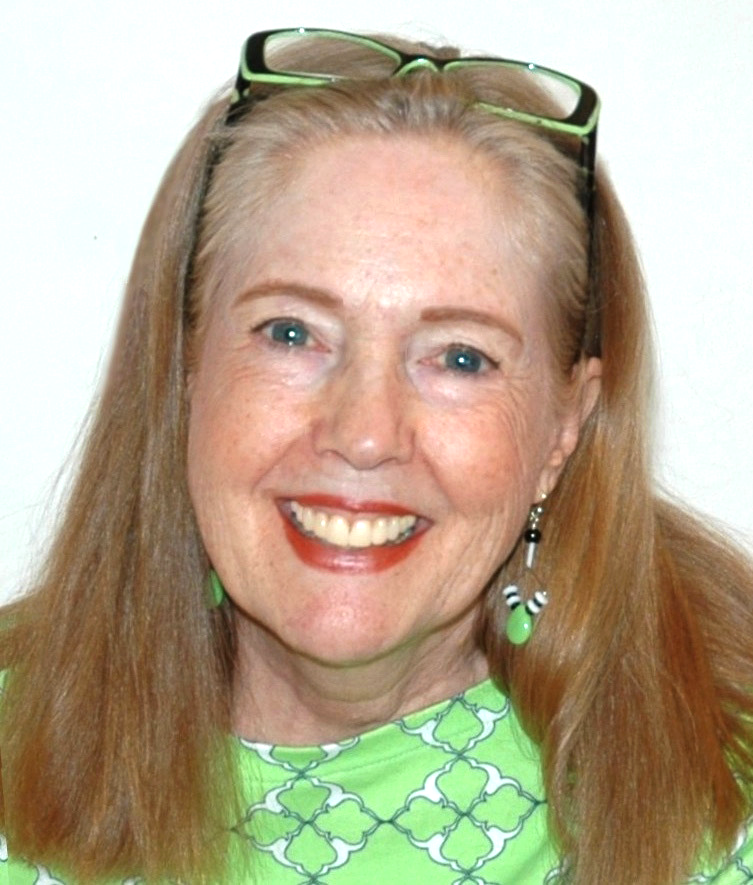
It wasn’t until I joined BAIPA that I had Michael show me how to do selfies (above) on my new iMac and asked Ella take a photo of me for my Facebook page.

GARDEN GURUS

GARDEN GURUS

GARDEN GURUS

It’s been a long, lovely spring, the hills still gloriously green well into May. Now that many of my Facebook friends are showcasing their gardens online, I’m wanting to add my voice and photos to the mix—because I once had a garden too.

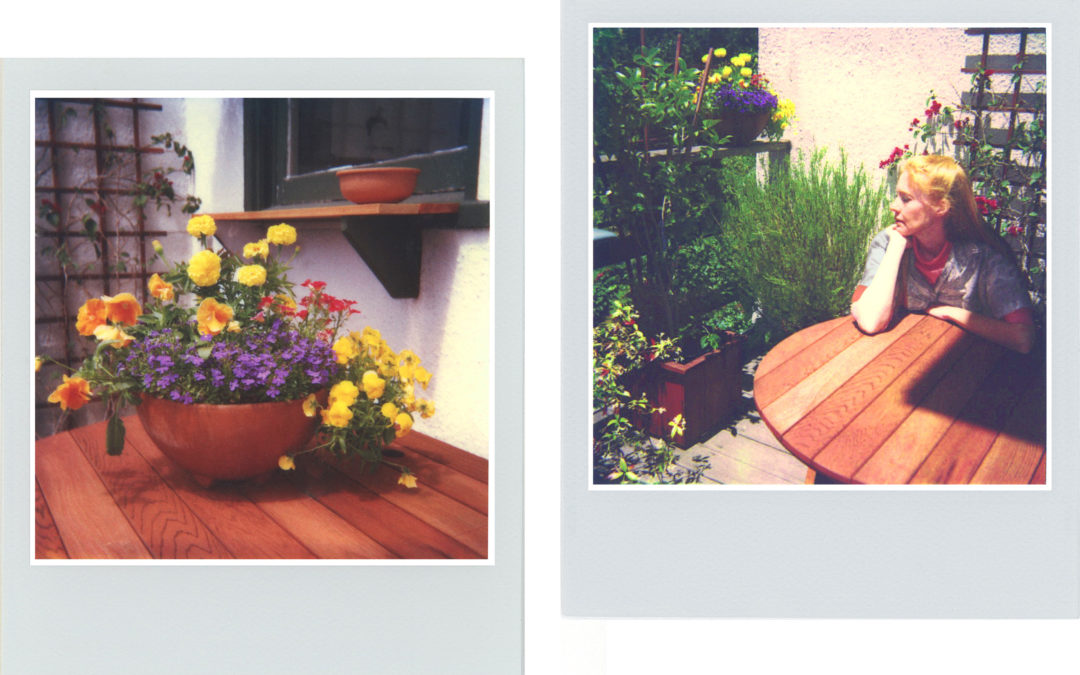
The images above are old Polaroids I scanned. In A Patchwork Memoir I wrote:

Because our apartment is so small, I thought it would be nice to add on another room—a colorful, fragrant outdoor annex. So I set out to transform our 6’ x 10’ deck—which stands one story above ground and looks out onto asphalt and the sagging roof of the carport—into a bower.

I started small, with a window box. When I went to East Bay Nursery to choose my first annuals, I was astonished at the prices. $2.50 for a pansy, petunia, or snapdragon? How could anything so beautiful be so cheap? From my annuals I learned that some of the best things in life are—almost—free.

No sooner had I planted my window box than we had a hard, driving rain. When I padded out the next morning, half-expecting my flowers to be battered to the ground, I found them jauntily upright, reminding me that “delicate” and “doughty” aren’t necessarily a contradiction in terms.

When I had enclosed the deck with flowering vines and bushes—bougainvillea, star jasmine, and a camellia—and added pots of lobelia, dahlias, and a pink breath of heaven, I decided there was only one thing missing, a small tree for the corner. So I scoured the East Bay nurseries—every last one—for the perfect arboreal roommate. “The canopy won’t be much larger than the root system,” I was advised by more than one nursery worker, “so if it’s in a standard 12”-diameter pot…” Pretty pitiful canopy, I thought. Then one day I happened upon the perfect “tree”—a wisteria pruned to a single trunk—in a narrow 5-gallon pot with a broad lush canopy and white starbursts of blooms. “Too bad that variety doesn’t have a fragrance,” I overheard an employee say in passing. Of course, the very first evening I went out to look at it, its white blossoms phantasmagoric in the darkness, it filled the air with perfume. From my irrepressible wisteria I learned, “Don’t believe everything you’re told, especially by the experts.”

The one thing I didn’t like about my new tree, though, was the rude, green-stained stake that supported it. The trunk looked strong enough to me, so I cut the cords that bound it to the stake—and it flopped right over, its canopy dragging on the ground, exhorting me, by its melodramatic collapse, to leave well enough alone!

So much for my lessons—I thought I’d graduated. Naïve gardener that I was, I imagined I could go on living in paradise. With serene complacency, I brunched among my flowers and wrote. Until the barbarian hordes invaded. Then I was battling aphids, spider mites, petunia bud worms, diabrotica beetles, carpenter bees, mildew, scale, and rust… For every flower, there was a predator. From my entire garden I learned, “There are no free brunches.”

THE EXPURGATED VERSION

THE EXPURGATED VERSION

THE EXPURGATED VERSION

Well, the conversion of our apartment building into a mini-dorm continues. Though I put in earplugs last night to shut out—or at least mute—any noise this morning, I awoke to my body vibrating with every hammer stroke, along with the entire structure around me. Nevertheless, I’m determined to continue too:

Another major player in my life was my father, who was—arguably—my primary parent and who would exert a powerful influence over me long after my mother divorced him and moved my brother and me halfway across the country. He was brilliant, it must be said—perhaps the most intellectually vital person I’ve ever known.

Everyone called my father Red, but it was years before I connected this nickname with the color, it sounded so completely different to my ears. He used to wear a nylon stocking over his head to train his dark red hair back, like Einstein’s. Throughout my childhood he spent the better part of every day holed up in his study, reading, except for the hours he taught at the university. I’d knock on the door timidly, afraid to interrupt him at his work.

When I was a child, he was the one I took all my questions to because he—literally—knew all the answers. He gave my brother a chemistry set (Doug says he was six at the time) and bought us both a microscope with which we peered at the one-celled organisms he brought home in jars of swamp water. He took us butterfly hunting, sent away for eggs, and eventually hatched from cocoons a cecropia moth and the most spectacular luna moth I’ve ever seen, even in museums—huge, pale green, its body covered with white down and its extravagant tails tinged with pink. Cases of insects of all kinds stood propped on dressers and hung from the walls.

He took us lizard hunting on cross-country trips. In our bedroom was a terrarium filled with reptiles. He created tools for their capture—a slip noose on the end of a fishing pole for the collared lizards that sunned themselves on the rocks of Oklahoma, a two-pronged fork on the end of a broom handle for the lizards that camouflaged themselves under the sands of New Mexico.

In Carlsbad Caverns we caught a giant millipede that wound up in the terrarium too (even with all those legs, it couldn’t move very fast). Throughout the southwest, we took night rides to capture tarantulas by the glow of our headlights. Near the Desert Museum outside Tucson, we caught two sun spiders—the most hideous arachnids I’ve ever seen—and put them in a jar. Later we discovered they’d completely dismembered each other.

On one of these trips we found an egg, brought it home, and waited to see what would hatch out of it. What finally emerged was a hog-nosed viper, a tiny spotted snake with a flattened nose. For weeks my father sent my brother and me down to the Triangle—the vacant lot at the end of the block, overgrown with weeds and nettles—to catch insects to feed it, but, curiously, it never seemed to eat. From among the last slides my father sent me a few years before his death—he was cleaning out mementos—I held one up to the lamplight, only to see that tiny snake swallowing a lizard twice its size.

There was the time Dad captured a porcupine and kept it in a barrel in the basement till the stink became unbearable. The time he fired his gun into a crevice in a rock and dragged out a rattlesnake. The time he returned from Mexico with the back seat full of five-foot iguanas, which he donated to the local zoo.

He took my brother hunting and both of us fishing—at the Twin City lakes and in the northern wilderness, where we would rent a cabin without water or electricity. Each morning we would row out on Lake Owen or Radison at dawn to the call of loons—and catch sunfish, crappies, bass, and northern pike that my dad would scale and fry up for breakfast. On one trip we even went on a long trek through the dense woods (in Minnesota, you had to worry about poison ivy, not poison oak) eager to see a small, newly discovered lake.

These are the activities that I shared with my father and brother in the years before my parents’ divorce. And this is the expurgated version of my relationship with my dad—the one without any mention of how much he intimidated me, the one he would have allowed me to write without threatening a lawsuit.